
Electronic -grade molybdenum trioxide: A review of crystal form selection, industrial preparation and lattice structure differences
In two-dimensional semiconductor materials, molybdenum disulfide (MoS₂ ) is considered a key candidate material for transistor channels in the post-Moore's Law era due to its atomic-level thickness, suitable band gap, and excellent gate control capability. However, the preparation of electronic-grade MoS₂ is highly dependent on the purity and crystal form of the precursor. High-purity molybdenum trioxide ( MoO₃ ) serves as an important bridge connecting molybdenum resources and semiconductor-grade MoS₂ . Unlike ordinary industrial molybdenum oxide, semiconductor-grade MoO₃ requires not only extremely low metal impurities but also specific selection of crystal form. This article systematically summarizes the purity requirements, industrial preparation methods, and lattice structure differences of semiconductor-grade MoO₃
introduction
In two-dimensional semiconductor materials, molybdenum disulfide (MoS₂ ) is considered a key candidate material for transistor channels in the post-Moore's Law era due to its atomic-level thickness, suitable band gap, and excellent gate control capability. However, the preparation of electronic-grade MoS₂ is highly dependent on the purity and crystal form of the precursor. High-purity molybdenum trioxide ( MoO₃ ) serves as an important bridge connecting molybdenum resources and semiconductor-grade MoS₂ . Unlike ordinary industrial molybdenum oxide, semiconductor-grade MoO₃ requires not only extremely low metal impurities but also specific selection of crystal form. This article systematically summarizes the purity requirements, industrial preparation methods, and lattice structure differences of semiconductor-grade MoO₃ .
I. Core Requirements for Semiconductor - Grade MoO₃
of semiconductor-grade MoO₃ can be summarized in two points: high purity and suitable crystal form .
In terms of purity , electronic-grade applications typically require MoO₃ purity of 4N (99.99%) or even 5N (99.999%) or higher to minimize the impact of impurities such as iron, copper, and silicon on the electrical performance of MoS₂ devices . Even with ordinary industrial molybdenum oxide reaching 3N, trace amounts of metallic impurities can still cause leakage channels or carrier scattering.
Regarding crystal form , while α- MoO₃ , commonly used in traditional CVD processes, is thermodynamically stable, it readily forms the molybdenum suboxide intermediate MoO₃₋ₓ upon reaction with sulfur vapor, leading to a MoO₂ - MoS₂ hybrid structure and contaminating the final crystal. In contrast, β- MoO₃ or β-phase-rich mixed-crystal MoO₃ possesses a more open three-dimensional framework and higher sulfidation reactivity, improving the conversion rate to MoS₂ and reducing the formation of harmful intermediates. Therefore, for semiconductor-grade MoS₂ , "purity priority, β phase even better" is the fundamental principle for precursor selection.
II. Industrial Preparation Methods of High-Purity Molybdenum Trioxide
The industrial production route for high-purity MoO₃ essentially involves converting molybdenum concentrate into molybdenum roasted sand, followed by further purification. The main processes can be categorized into wet processes, pyrometallurgical processes, and several enhancement technologies.
1. Hydrometallurgy: Ammonia leaching-thermal decomposition method (mainstream process)
Molybdenum concentrate is oxidatively roasted to obtain molybdenum calcinate, which is then leached with ammonia water to convert molybdenum into a soluble ammonium molybdate solution, while impurities such as iron and silicon remain in the slag. The purified solution is acid-precipitated and crystallized to obtain ammonium paramolybdate, which is finally calcined at 500–700℃ to obtain high-purity MoO₃ . This route is the most mature technology, and the product purity can reach over 99.95% , making it the main method for the commercial production of high-purity MoO₃ . Its limitations lie in the relatively long process and the generation of ammonia-containing wastewater, resulting in high environmental treatment costs.
2. Pyrometallurgy: Sublimation-condensation method
Taking advantage of the significant sublimation of MoO₃ at high temperatures, molybdenum calcined ore is heated to 900–1100 ℃ , and the MoO₃ vapor is collected after volatilization. Traditional pyrometallurgical methods result in low molybdenum recovery rates (65–85%) and require high-quality raw materials. Improved methods include steam atmosphere and vacuum sublimation : steam selectively enhances MoO₃ evaporation, yielding MoO₃ with a purity exceeding 99.99% at 1050℃ ; vacuum sublimation operates at low pressure and 900℃, producing 3N-grade products from high-impurity calcined ore without the need for ammonia and with a shorter process.
3. Microwave roasting method
Microwave selective heating is used to directly process low-grade molybdenite. In a microwave field of 700–900℃ , the MoO₃ vapor generated by the oxidation of MoS₂ is carried out by the gas flow and collected, achieving a purity of 99.94%–99.96% and a molybdenum yield of 96.5%–97.3% . This method has a short process and relatively low energy consumption, making it suitable for the efficient utilization of low-grade ores.
4. Additive-assisted volatilization roasting
For low-grade or complex molybdenum calcined sand, purification is enhanced by introducing additives. For example, the metaphosphate-quartz-assisted method can volatilize 97.1% of molybdenum at 900–1050℃, achieving a product purity of 99.9%, which can reach 99.99% after water washing, with no wastewater discharge; boric acid-assisted vacuum roasting at 5 wt % H₃BO₃ , 1300℃, and 10 Pa achieves molybdenum volatilization and recovery rates of 98.69% and 95.02 % , respectively, with the condensed product purity exceeding 99.9%.
5. Pelletizing and roasting method
Molybdenum concentrate is mixed with binders such as kaolin to form pellets before oxidative roasting. Pelletizing reduces dust generation and impurity entrainment. Roasting at 1050℃ for 1 hour yields MoO₃ with a purity of 99.99% and a molybdenum recovery rate of 91.61% . The process generates no wastewater, and the high-concentration SO₂ flue gas can be recovered for acid production.
|
Process route |
Core Principles |
Typical purity |
molybdenum recovery rate |
Main features |
|
Wet process (ammonia leaching - thermal decomposition) |
Ammonia water selectively dissolves molybdenum, which then decomposes into ammonium molybdate. |
≥99.95% |
85–95% |
The technology is the most mature, and the purity is stable; however, the process is lengthy and involves ammonia-containing wastewater. |
|
Pyrometallurgy (sublimation-condensation) |
Using the high volatility of MoO₃ to separate impurities |
≥99.99% |
65–85% |
The process is shorter; traditional methods have low recovery rates and high requirements for raw materials. |
|
Microwave roasting |
Microwave selective heating for rapid oxidation and volatilization |
99.94%–99.96% |
96.5%–97.3% |
Short process, high yield; suitable for low-grade ore |
|
Additives to aid volatilization |
Adding specific substances enhances the decomposition and volatilization of molybdate. |
≥99.9%, up to 99.99% |
Up to 97.1% |
High recovery rate; some processes produce no wastewater; specific additives are required. |
|
Pelletizing and roasting |
Pelletizing reduces dust entrainment and promotes direct oxidation and volatilization. |
99.99% |
91.61% |
High purity, no wastewater, and recyclable byproducts; requires binder for pelletizing. |
III. Differences in the crystal structure of molybdenum trioxide
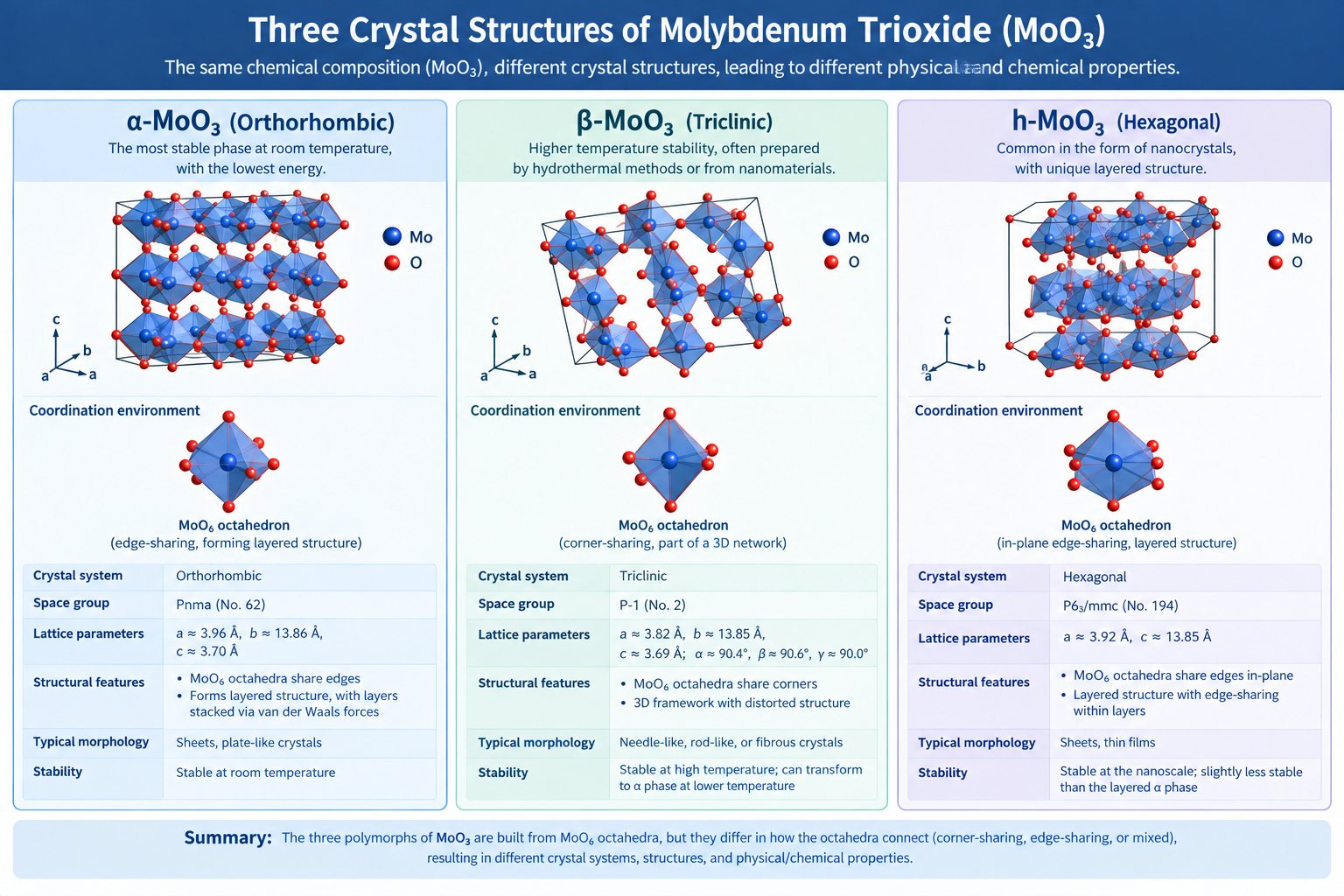
The basic structural unit of MoO₃ is the MoO₆ octahedron , and different connection methods result in different crystal forms.
α- MoO₃ (orthorhombic system) : thermodynamically most stable. MoO₆ octahedrons form a bilayer structure through edge-sharing , with layers stacked by van der Waals forces. Morphology is typically needle-like, lamellar, or plate-like. The main phase of commercially available MoO₃ is usually the α phase.
β- MoO₃ (monoclinic system) : Metastable with a more open structure. MoO₆ octahedra are connected only by shared corners , forming a three-dimensional framework similar to ReO₃ , with a density (4.50 g/cm³) lower than the α phase (4.75 g/cm³). It typically appears as spherical or yellow powder. The β phase transforms into the α phase at temperatures above 350℃ ; therefore, temperature windows must be carefully considered when utilizing its high reactivity.
h- MoO₃ (hexagonal crystal system) : Also a metastable state, it is a hexagonal crystal form with a one-dimensional tunnel structure composed of octahedra with common edges, and its morphology is often a hexagonal prism.
IV. The Influence of Different Production Processes on Crystal Form and Morphology
Different process routes have significantly different abilities to control the crystal structure of MoO₃ .
Wet process (ammonia leaching-thermal decomposition) : Usually produces thermodynamically stable α- MoO₃ , with morphologies mostly in the form of plates or nanoplates. The crystal morphology is affected by the precursor decomposition pathway, and the crystallinity is determined by the calcination temperature .
Pyrometallurgical process (sublimation-condensation) : This is the most effective method for directly controlling crystal form . The condensation temperature is the decisive variable: high-temperature condensation (>600℃) tends to form lath-shaped α- MoO₃ ; low-temperature condensation (<450℃) produces spherical β- MoO₃ . By designing a multi-stage condensation system, it is even possible to simultaneously prepare the α and β phases.
Microwave calcination : The product is usually α- MoO₃ , but the microwave field promotes the rapid formation and growth of crystal nuclei, making the crystal structure more regular and the crystallinity better.
Additive-assisted approach : Ions or surfactants in solution can interfere with the octahedral bonding of MoO₆ at the molecular level. For example, the presence of nitric acid (HNO₃ ) induces the formation of β- MoO₃ , while the absence of HNO₃ selectively generates α- MoO₃ ; surfactants can then regulate the morphology of α- MoO₃ to obtain nanoneedle-like or plate-like structures.
V. Selection Recommendations for Semiconductor-Grade MoS₂
Considering both purity and crystal form requirements, the selection of MoO₃ precursors for semiconductor-grade MoS₂ can follow these principles:
First, purity is paramount. High-purity MoO₃ with a purity of 4N or higher, ideally 5N, should be selected . Wet processing methods produce products with stable purity, but these are typically in the α phase; pyrometallurgical methods can achieve 99.99% purity , and the crystal form can be customized by adjusting the condensation temperature.
Second, in terms of crystal form, the β phase or a mixed phase rich in the β phase is preferred. β- MoO₃ has higher reactivity with the sulfur source, which helps to achieve more complete sulfidation in the CVD process and reduces the contamination of MoO₃₋ₓ intermediates . If the α phase is used, its lower reactivity needs to be compensated for by increasing the partial pressure of sulfur vapor and optimizing the temperature program.
Third, select the process based on the target product form. For wafer-level thin films (CVD/MOCVD), it is recommended to use high-purity β-phase or mixed-phase MoO₃ powder , and pay attention to shortening the residence time of the β-phase in the high-temperature region; for high-purity powder or nanosheets (CVT/hydrothermal method), high-purity β-phase or mixed-phase is also preferred; if wet α-phase products are used, it is necessary to evaluate the subsequent sulfidation conditions or add a final purification process.
Conclusion
Semiconductor-grade molybdenum trioxide (MoO₃) is not simply an upgrade of ordinary industrial MoO₃, but rather a comprehensive control of purity, crystal form, and morphology. The wet ammonia leaching-thermal decomposition method provides a mature and stable source of high-purity α- MoO₃ ; the pyrometallurgical sublimation-condensation method directly controls the α/β crystal form through condensation temperature; and emerging technologies such as microwave calcination, additive-assisted calcination, and pelletizing calcination show potential in terms of recovery rate and environmental friendliness. For the preparation of electronic-grade MoS₂ , high -purity MoO₃ precursor + controlled sulfidation + defect engineering constitute the core of the process, with the β-phase or β-phase-rich high-purity MoO₃ being the key starting point for improving sulfidation reaction efficiency and suppressing intermediate contamination. In the future, with the maturation of wafer-level two-dimensional semiconductor manufacturing technology, the requirements for crystal form customization and batch stability of high-purity MoO₃ will further increase.
Shanghai Canal International Trade Co., Ltd. supplies high-purity molybdenum trioxide from Climax, USA. They offer molybdenum trioxide produced via both sublimation and wet processes, with a purity up to 99.99%. Details can be found on their official website.
https://www.canalchem.com/products/prd-category-004/product-059.html