
Benda-Lutz Aluminum Pigments in Powder Coating Applications
Benda-Lutz is the metallic effect pigment brand of Sun Chemical (DIC). Its aluminum pigments are widely used in industrial coatings, powder coatings, printing inks, plastics, and other fields.
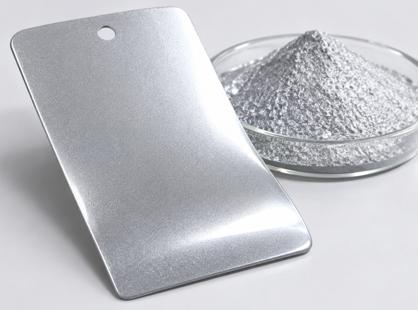
Benda-Lutz is the metallic effect pigment brand of Sun Chemical (DIC). Its aluminum pigments are widely used in industrial coatings, powder coatings, printing inks, plastics, and other fields.
The Benda-Lutz grades most commonly used in powder coatings – 2081, 2091, and 7080 – are all aluminum flake pigments. Their most important difference is whether they are leafing or non-leafing. This distinction directly affects the metallic appearance, gloss, color performance, abrasion resistance, and coating adhesion of powder coatings.
From the perspective of powder coating applications:
- 2081: A decorative aluminum pigment oriented toward high metallic gloss and strong reflectivity.
- 2091: An aluminum pigment oriented toward a fine, high-brightness, precisely chrome-silver effect.
- 7080: A non-leafing aluminum pigment oriented toward uniform metallic effects, colored metallic effects, and functional coatings.
I. Basic Characteristics and Technical Differences of the Three Products
|
|
2081 |
2091 |
7080 |
|
Type |
Leafing |
Leafing |
Non-leafing |
|
Particle size (D50) |
10 μm |
5 μm |
7 μm |
|
Appearance |
Brilliant |
Brilliant |
Silky luster |
The Difference Between Leafing and Non-Leafing
This is the basis for understanding the application differences among the three products.
1. Leafing aluminum pigments – 2081, 2091
Leafing aluminum pigments have a strong tendency to migrate to the surface. During film formation, the aluminum flakes concentrate at the coating surface and align parallel to it, forming a metallic layer with strong reflecting power.
Key characteristics:
- High metallic reflectance.
- High surface gloss.
- Pronounced silver metallic effect.
- Conducive to chrome-silver and mirror-like metallic effects.
- Surface enrichment of aluminum flakes provides a degree of barrier protection to the coating.
2. Non-leafing aluminum pigments – 7080
Non-leafing aluminum pigments do not migrate noticeably to the coating surface; instead, they are distributed evenly throughout the film, forming a relatively uniform metallic reflecting structure.
Key characteristics:
- More uniform metallic effect.
- Suitable for tinting in combination with transparent or semi-transparent pigments.
- Good coating adhesion and recoat compatibility.
- Generally better rub and abrasion resistance.
- Suitable for primers, hammer-tone finishes, and colored metallic coatings.
For the technical differences between leafing and non-leafing pigments and the corresponding performance characteristics, refer to Sun Chemical's product technical literature.
II. Benda-Lutz 2081 in Powder Coating Applications
Leafing aluminum pigment – High-reflectance metallic effect
1. Product Introduction
Benda-Lutz 2081 is a leafing aluminum flake pigment with a strong surface-migration capability.
During film formation, the flakes tend to gather at the coating surface and form a continuous metallic reflecting layer, giving the coating a distinct silver metallic luster.
2. Mechanism of Action in Powder Coatings
Powder coatings generally consist of resin, curing agent, pigments and fillers, and additives. After spraying, the powder is heated, melts, flows level, and crosslinks and cures.
When 2081 is added, the aluminum flakes gradually reorient as the coating melts and flows, and tend to reach a higher proportion at the surface layer.
The following effects result:
First, a highly reflective metallic surface is formed.
Aluminum flakes reflect visible light strongly. When large numbers of flakes overlap and align parallel to the substrate surface, a pronounced metallic reflection is created.
Second, the silver metallic appearance is enhanced.
2081 gives powder coatings a distinct silver metallic appearance, making it suitable for products where a metallic decorative look is important.
Third, a degree of surface barrier action is provided.
The enrichment of aluminum flakes at the coating surface helps form a physical barrier layer that reduces the direct influence of the external environment on the coating.
Note that this barrier action cannot be equated with a complete anticorrosion system; final anticorrosion performance still depends on the resin system, substrate preparation, and coating build.
3. Main Applications of 2081 in Powder Coatings
4. Main Technical Advantages of 2081
|
Technical advantage |
Value for powder coatings |
|
Leafing structure |
Flakes migrate to the surface, enhancing metallic reflection |
|
Larger particle size |
Compared with 2091, allows further development of different metallic particle appearances |
|
High metallic brightness |
Enhances the silver metallic look of the coating |
|
Surface barrier action |
Helps improve the coating's barrier against the external environment |
|
Pronounced decorative effect |
Suitable for decorative powder coatings with a strong metallic look |
2081's greatest advantage is that it delivers a distinct silver metallic effect in powder coatings: the surface alignment of leafing flakes creates strong light reflection, giving the coating more prominent metallic gloss and decorative appeal.
III. Benda-Lutz 2091 in Powder Coating Applications
Leafing aluminum pigment – Fine, high-brightness chrome-silver effect
1. Product Introduction
Benda-Lutz 2091 is also a leafing aluminum flake pigment, with an average particle size of approximately 5 μm, smaller than that of 2081. Because the flakes are finer, their alignment and visual performance in the coating are generally more refined.
Sun Chemical's technical literature on leafing aluminum pigments notes that finer flakes have greater mobility during film formation, which favors a more regular alignment, a clearer chrome-silver effect, and high gloss with chrome-like reflectivity.
2. Mechanism of Action in Powder Coatings
The basic mechanism of 2091 in powder coatings is the same as that of 2081, but because its particles are finer, different optical performance can be achieved under suitable formulation and film-forming conditions. This is mainly reflected in the following aspects:
First, a finer metallic surface is formed.
Fine flakes form a relatively delicate metallic arrangement, reducing the noticeable graininess caused by coarser particles.
Second, the metallic gloss of the coating is increased.
Surface enrichment and oriented alignment of the flakes produce strong light reflection, giving the film a bright silver metallic appearance.
Third, the chrome-silver visual effect is improved.
When the flakes are aligned relatively flat and uniformly, a clearer and finer metallic reflection is obtained, which suits high-end decorative powder coatings.
It should be noted that a finer particle size does not necessarily mean higher brightness than 2081 in every formulation. Final gloss and mirror-like appearance are also affected by flake thickness, morphology, surface condition, resin flow leveling, and curing conditions.
3. Main Applications of 2091 in Powder Coatings
4. Main Technical Advantages of 2091
|
Technical advantage |
Value for powder coatings |
|
Fine particle size |
Favors a fine, delicate metallic surface |
|
Leafing structure |
Enhances surface metallic reflection |
|
High gloss |
Meets the requirements of high-brightness silver powder coatings |
|
Chrome-silver visual effect |
Suitable for high-end metallic decorative coatings |
|
Surface alignment capability |
Favors a clearer, more regular reflection |
The core advantage of 2091 lies in the combination of fine particle size and leafing structure, which helps powder coatings achieve a finer metallic texture and a high-brightness silver effect. It is particularly suitable for decorative powder coatings with demanding surface appearance requirements.
IV. Benda-Lutz 7080 in Powder Coating Applications
Non-leafing aluminum pigment – Uniform metallic effect
1. Product Introduction
Benda-Lutz 7080 is a non-leafing aluminum flake pigment with an average particle size of approximately 7 μm. Unlike 2081 and 2091, 7080 does not migrate noticeably to the coating surface but is dispersed throughout the film. This structure produces a more uniform metallic reflection while embedding more flakes in the resin system. 7080 is suitable for single-coat systems, hammer-tone coatings, primers, marine coatings, anticorrosive coatings, zinc-dust-containing coatings, and heat-resistant coatings.
2. Mechanism of Action in Powder Coatings
As a non-leafing aluminum pigment, 7080 keeps the flakes dispersed within the resin during curing rather than concentrating them heavily at the surface. This produces the following characteristics:
First, the metallic pigment is uniformly distributed.
The flakes are evenly dispersed throughout the film, and incident light reflects off the surfaces of different flakes, creating an overall uniform metallic effect.
Second, formulation flexibility for colored metallic effects is increased.
7080 can be used with transparent or semi-transparent pigments; combinations of different pigments allow the development of silver-gray, blue-silver, red-silver, metallic-gray, and other colored metallic coatings.
Third, the rub resistance of the coating surface is improved.
Because the flakes are embedded more within the resin rather than concentrated at the surface, it generally offers better friction, abrasion, and chemical resistance than leafing aluminum pigments.
Fourth, it favors coating adhesion and downstream processing.
Non-leafing aluminum pigments are generally better suited to formulations requiring good resin bonding, recoating, and intercoat adhesion.
3. Main Applications of 7080 in Powder Coatings
4. Main Technical Advantages of 7080
|
Technical advantage |
Value for powder coatings |
|
Non-leafing structure |
Flakes are uniformly dispersed within the coating |
|
Uniform metallic effect |
Reduces local variation caused by surface concentration of metallic pigment |
|
Good resin bonding |
Favors coating adhesion and subsequent recoating |
|
Rub resistance |
Helps improve the wear resistance of the coating surface |
|
Formulation flexibility |
Suitable for colored metallic coatings |
|
Multiple functional applications |
Can be used in hammer-tone, primer, and protective systems |
7080's greatest advantage is its non-leafing structure, which distributes the flakes uniformly within the powder coating, preserving the metallic decorative effect while balancing coating adhesion, wear resistance, and formulation flexibility.
V. Comprehensive Comparison of the Three Products in Powder Coatings
This is the part most worth attention when selecting products and promoting them to customers.
|
Comparison item |
2081 |
2091 |
7080 |
|
Pigment type |
Leafing |
Leafing |
Non-leafing |
|
English designation |
Leafing |
Leafing |
Non-leafing |
|
Particle size D50 |
10 μm |
5 μm |
7 μm |
|
Surface distribution |
Surface enrichment |
Surface enrichment |
Uniform distribution within the coating |
|
Metallic brightness |
High |
High |
Formulation-dependent, generally softer |
|
Metallic appearance |
Pronounced metallic look |
Fine chrome-silver look |
Uniform metallic look |
|
Coating rub resistance |
Generally lower for leafing types |
Generally lower for leafing types |
Generally good |
|
Subsequent recoating |
Requires testing and verification |
Requires testing and verification |
Generally more favorable |
|
Typical applications |
High-brightness silver decoration |
Fine chrome-silver decoration |
Hammer-tone, colored metallic, functional coatings |
Note: Brightness, wear resistance, and recoat performance are application judgments based on pigment type and particle size characteristics; they are not measured rankings of the three products under identical formulation and process conditions.
VI. Practical Application Processes for the Three Aluminum Pigments in Powder Coatings
There is an important difference between aluminum flake pigments and ordinary powder pigments: aluminum flakes have a lamellar structure, and the metallic effect is closely related to flake integrity and orientation. The addition process therefore directly affects the final result.
1. Dry blending
Aluminum powder is mechanically mixed with finished powder coating base powder so that the flakes are distributed evenly among the resin particles.
Advantages:
- Relatively simple production process.
- Lower equipment investment.
- High production flexibility.
- Suitable for small batches or multi-product development.
Disadvantages:
- Flakes and resin powder may separate.
- Color unevenness may occur during spraying.
- Edge accumulation and local differences in metallic effect are likely.
- The color and metallic effect of reclaimed powder may change.
2. Bonding process
Bonding combines the metallic pigment with powder coating base powder under controlled temperature and mixing conditions, so that the flakes adhere to the surface of the resin particles.
Main advantages:
- Reduces the risk of separation between metallic pigment and resin powder.
- Improves powder distribution uniformity during spraying.
- Improves batch-to-batch appearance consistency.
- Helps improve the consistency of reclaimed powder.
The key to the bonding process is control of temperature and shear. Excessive temperature or shear can damage the flakes or their surface protective layer. Bonding generally helps improve spraying stability and appearance consistency.
3. Direct addition by conventional extrusion is not recommended
Aluminum flake pigments are lamellar effect pigments and are prone to bending, breakage, and morphological change under high-shear extrusion, which impairs the metallic reflection.
The usual practice is therefore to add the metallic pigment after the powder coating base powder has been produced, using a suitable dry blending or bonding process.
Shanghai Canalchem distributes Benda-Lutz aluminum pigments from Sun Chemical, with many grades used in powder coatings and plastics.
https://www.canalchem.com/products/paint-ink/product-058.html