
Introduction to Metal Injection Molding (MIM) Process
金属注射成型(Metal Injection Molding,简称MIM) 是一种将塑料注射成型的几何自由度与金属材料的性能优势相结合的先进制造技术。它被广泛应用于消费电子、汽车、医疗器械等领域,特别适合大批量生产小型、高精度、形状复杂的金属零件。
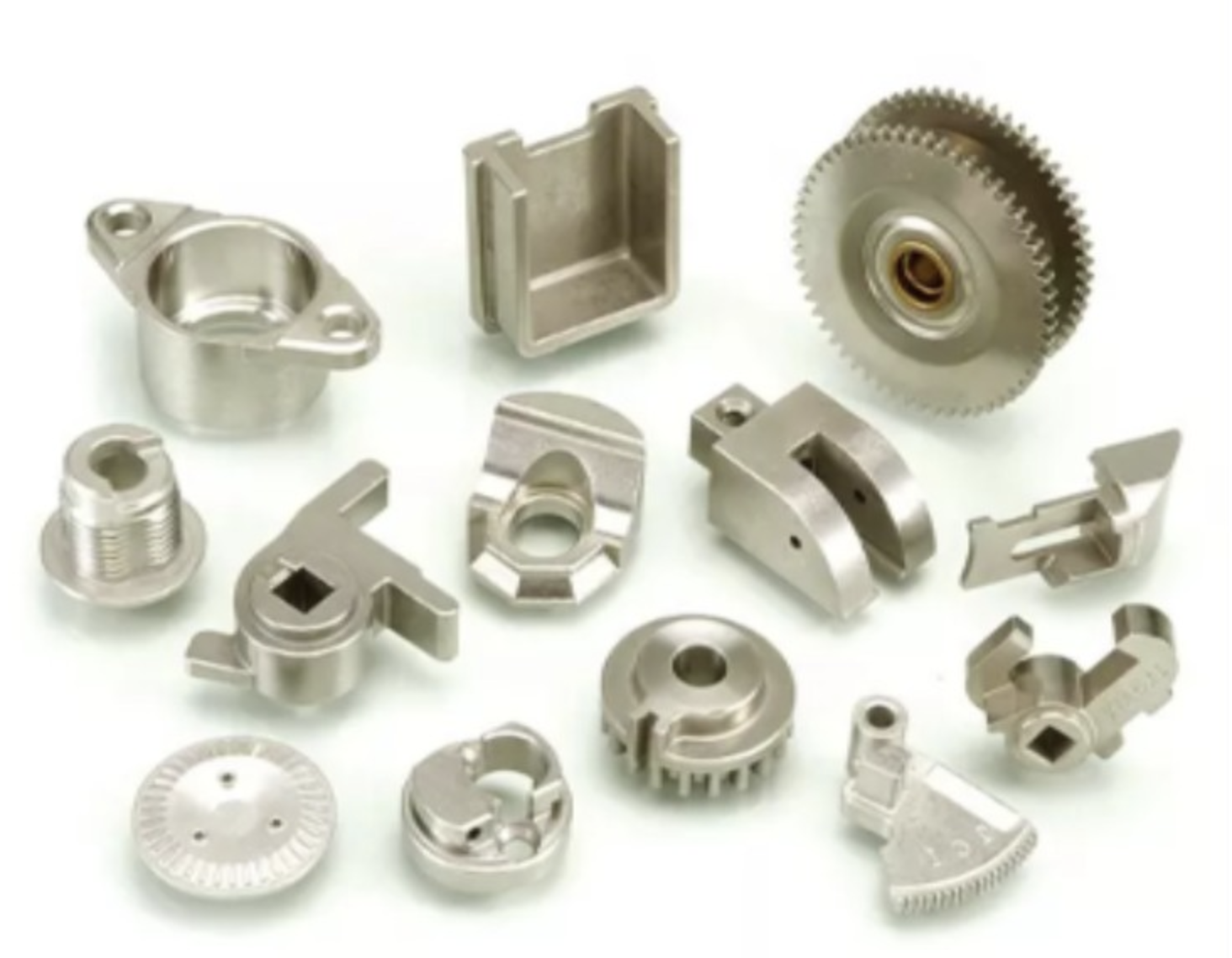
Metal injection molding (MIM) is an advanced manufacturing technology that combines the geometric freedom of plastic injection molding with the performance advantages of metal materials. It is widely used in consumer electronics, automotive, medical devices and other fields, and is particularly suitable for mass production of small, high-precision, and complex-shaped metal parts.
一、Core Principles and Main Processes
The core idea of MIM (Metal Injection Molding) is to mix metal powder with an organic binder, shape it into complex forms using an injection molding machine, and then debind and sinter it to obtain high-density metal parts. This process integrates two technologies: powder metallurgy and plastic injection molding.
Its process mainly includes four steps:
- Preparation of the "feed" : Micron-sized metal powder (typically 0.5-20 μm) is uniformly mixed with a certain proportion of binder (such as thermoplastics, waxes, etc.) to form a granular "feed" with good flowability. The binder volume percentage is generally 30%-50%.
- Injection molding : The "feed" material is heated and injected into a precision mold in an injection molding machine. After cooling, a blank with a shape similar to the final part is obtained, which is called a " green blank ".
- Degreasing : Most of the binder in the "green body" is removed by chemical or thermal decomposition methods to form a porous " brown body ".
- Sintering : The "brown blank" is sintered at a temperature close to the metal's melting point (usually above 1000°C). During this process, metal particles diffuse and bond together, causing the part to shrink and densify, ultimately resulting in a finished product with excellent mechanical properties. The density of MIM products can reach 95%-98% or more of the theoretical density.
Since the parts shrink by 15%-20% during the sintering process, the mold design must accurately calculate this shrinkage amount in advance.
二、Core advantages
MIM's unique manufacturing process gives it significant advantages in specific application scenarios:
- High degree of design freedom and strong forming capability : It can manufacture complex three-dimensional structures that are difficult to process by traditional processes (such as machining and precision casting), such as thin-walled parts with a wall thickness of only 0.2mm , micro-holes, deep holes, threads, gears, etc., all of which can be formed in one step.
- High material utilization : As a near-net-shape forming technology, the material utilization rate can exceed 95% , making it especially suitable for processing precious metals such as titanium and tungsten.
- Excellent overall performance : Due to its high density, its mechanical properties are comparable to those of forged materials, and it has a good surface finish (roughness Ra can reach <3μm or even 1μm ).
- Suitable for high-volume, high-efficiency production : Once the mold is developed, the production cycle is fast, and annual output from 5,000 to millions of pieces can be achieved economically. When the output exceeds 10,000 pieces , the cost per piece can be reduced by 30%-50% compared to traditional processes .
- Wide range of material choices : Suitable for stainless steel, low alloy steel, titanium alloy, cemented carbide, tungsten alloy, precious metals and other materials.
三、Main application areas
MIM technology has been widely used in many industries:
- Consumer electronics : Precision components for mobile phones, computers, and smart wearable devices (such as hinges, SIM card trays, camera rings, etc. for foldable screen phones).
- Automotive industry : Sensors, precision connectors, airbag components, clutch components, etc.
- Medical devices : surgical instruments, dental frames, biopsy forceps, etc.
- Hardware tools : drill bits, cutter heads, screwdriver heads, wrenches, etc.
- Emerging fields : In the field of humanoid robots, MIM is expected to be used to manufacture key components such as reducer gears and dexterous hand joints.
四、Limitations and challenges
Despite its obvious advantages, MIM technology also faces some inherent limitations:
- It is mainly suitable for small parts : typically weighing less than 250 grams per piece . Manufacturing large parts remains economically and technically challenging.
- High initial investment : Mold design and manufacturing are difficult and time-consuming (up to 3-6 months), costing hundreds of thousands of yuan, making them unsuitable for small-batch production.
- The process control is complex : the process parameters (such as temperature and time) in the degreasing and sintering stages require extremely precise control, and improper handling can easily lead to product deformation or cracking.
- Quality control is difficult : detecting internal defects requires specialized equipment such as X-rays, which increases quality control costs.
五、Materials required for MIM
The formulation of MIM is technically called " feedstock ," and it mainly consists of two parts: metal powder and binder . These two are precisely proportioned and mixed to form an injection molding raw material with good flowability.
Core component 1: Metal Powder
This is the final framework of the MIM product, determining the material and core performance of the finished product. Metal powder typically accounts for about 60% of the feed volume and as high as 85%-93% by mass .
Commonly used metal powder materials are very extensive, mainly including:
- Stainless steel and iron-based alloys : the most mainstream choice. Common grades include 304L, 316L, and 17-4PH , used in consumer electronics, medical devices, etc.
- Low alloy steel : commonly used in the manufacture of structural components such as automotive parts and hardware tools that require a certain level of strength.
- Tool steel : Used to manufacture tools such as drill bits and cutter heads that require high hardness and wear resistance.
- Titanium and titanium alloys : used in aerospace, medical implants and other fields with extremely high requirements for lightweight and biocompatibility.
- Copper and copper-based alloys : used in the manufacture of electronic connectors, heat sinks, etc.
- Tungsten alloys : used to manufacture high-density parts, such as counterweights and radiation shielding components.
- Nickel and nickel-based alloys, cobalt-chromium alloys , etc. are also often used for specific needs.
Core component two: Binder
The binder is the soul of MIM technology, acting as a "temporary glue." It imparts fluidity to the metal powder, allowing it to be formed in the mold and maintaining the shape of the blank before debinding. The binder typically accounts for about 40% of the feed volume and about 7%-15% by mass .
Adhesives are not a single substance, but a complex multi-component system, typically including the following categories:
- Backbone /Polymer : Provides the main strength of the green body during debinding and sintering, preventing collapse. Examples include EVA, polyoxymethylene (POM) , high-density polyethylene (HDPE) , and polypropylene (PP) .
- Filler/Wax : Reduces feed viscosity, improves flowability, and facilitates injection molding, such as paraffin wax (PW) , microcrystalline wax , etc.
- Lubricant/Surfactant : Reduces friction between metal powder and mold wall, and between powder particles, such as stearic acid (SA) , polyvinyl alcohol (PVA) , etc.
- Plasticizers : Improve the flexibility and processing properties of feed, such as polyvinyl alcohol (PVA) and POE .
- Dispersant : Prevents metal powder from agglomerating and ensures its uniform distribution in the binder.
- Stabilizers/antioxidants : prevent binders from decomposing during high-temperature mixing or injection molding.
Shanghai Canal Materials provides multiple components for MIM adhesives:
Skeleton agents: PVAC from Wacker Chemie (Germany) and PVB from Sekisui (Japan) can replace EVA, providing support strength and adhesion.
Dispersant: EBS from Kao Corporation of Japan, which helps to disperse powder evenly; an industry standard product.
Lubricating release agent: Zinc stearate from Singapore SUN ACE, made by dry process, with low moisture content, making it more suitable for lubricating and releasing MIM.
Flow agent: Fumed silica from Wacker Chemie, Germany, to increase powder flowability.
Wear-resistant modifier: Molybdenum disulfide from Climax, USA, provides a metallic luster while increasing surface lubrication and wear resistance.